
Fortinet FortiGate 100F Firewall
FortiOS firewall with 10G optical and Gigabit interfaces for traffic control and network segmentation.
verified Key Technical Highlights
- check_circle Two 10G SFP+ slots.
- check_circle Four dedicated Gigabit SFP ports.
- check_circle Four shared RJ45/SFP interfaces.
- check_circle SOC4 platform running FortiOS.
Overview
When headquarters scale past 100–300 endpoints across multi-ISP fiber links, branch VPNs, and segmented server/IoT VLANs, basic NAT routers run short on security inspection and east-west enforcement. Built around Fortinet's SOC4 security processor (NP6XLite + CP9XLite) running FortiOS, the FortiGate 100F provides 2× 10G SFP+ slots (X1/X2), 18× dedicated Gigabit RJ45 ports, 4× dedicated Gigabit SFP slots (13–16), and 4× shared RJ45/SFP pairs (17–20). Clean engineering starts with respecting the shared-port mutual exclusion rule and budgeting ongoing FortiGuard/FortiCare renewal terms.

Port-planning guardrail: ports 17–20 share one active medium per pair
Along the front bezel, the FortiGate 100F pairs 2× 10G SFP+ (X1/X2), 18× dedicated RJ45 Gigabit, and 4× dedicated SFP (13–16) with four shared interface pairs labeled 17 through 20.
Per Fortinet architecture, each shared pair (17–20) operates exclusively as either RJ45 copper or SFP fiber at any given instant—never both simultaneously. Count active concurrent ports accurately before finalizing fiber patch panels.
Three enterprise roles leveraging SOC4 NP6XLite and CP9XLite acceleration
Dedicated NP6XLite and CP9XLite co-processors accelerate steady-state firewall sessions and IPsec site-to-site VPN encryption without pegging general CPU cores.
The 10G SFP+ slots (X1/X2) natively feed core distribution switches or FortiLink switch stacks so VLAN segmentation and quarantine rules extend cleanly down to access edge ports.
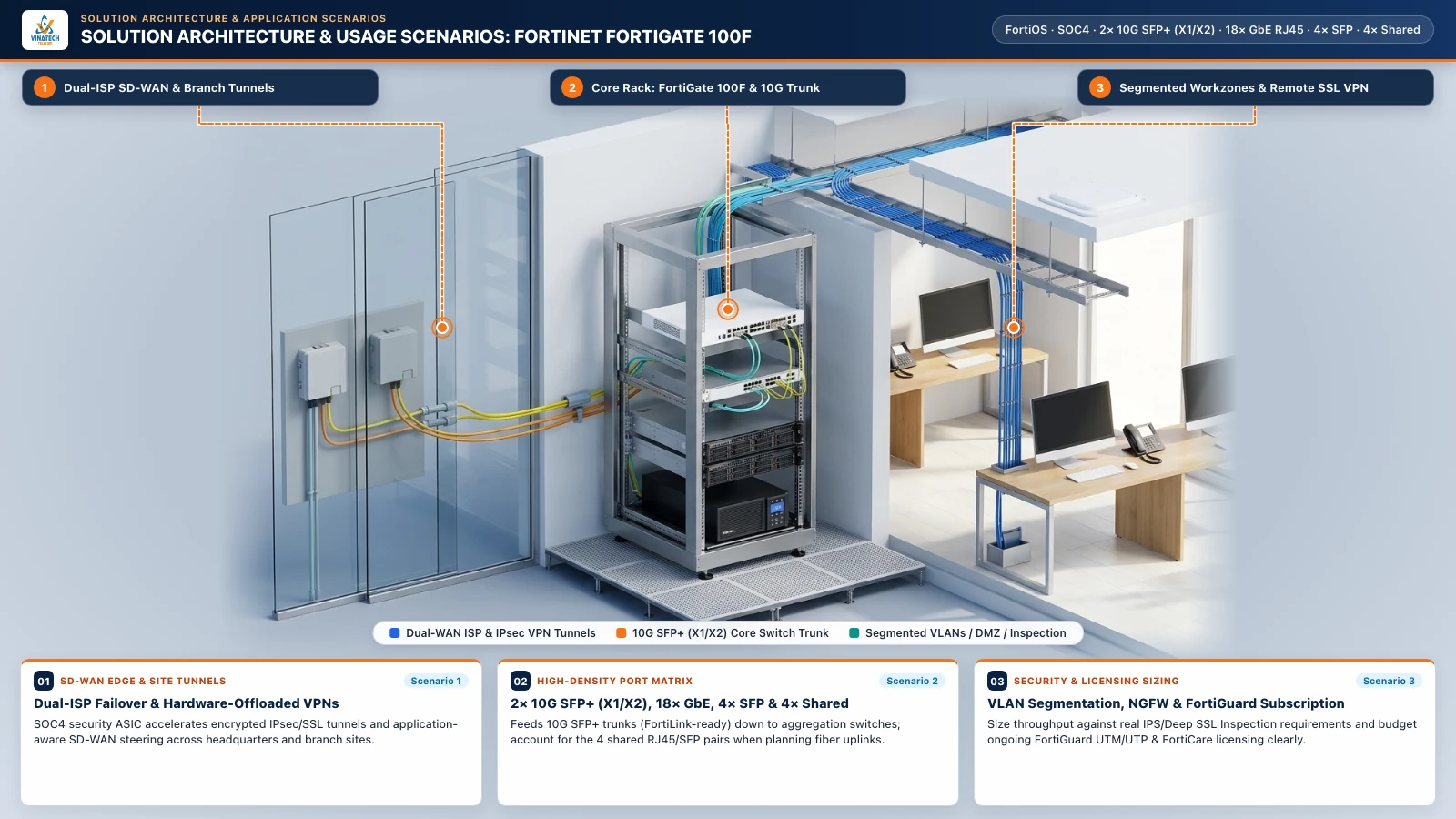
- Scenario 01 — Multi-ISP SD-WAN edge & hardware-offloaded VPNs: SOC4 ASICs offload IPsec/SSL tunnels and application-aware SD-WAN link monitoring across dual or triple ISP fiber trunks.
- Scenario 02 — High-density 10G SFP+ & shared RJ45/SFP port matrix: Aggregates 10G SFP+ X1/X2 trunks to core switches alongside 18× GbE + 4× dedicated SFP (13–16); accounts strictly for ports 17–20 running one medium per pair.
- Scenario 03 — Deep VLAN segmentation & FortiGuard license planning: Enforces zero-trust zones across servers, staff, guest, and CCTV networks while aligning SSL inspection throughput against FortiGuard UTM/UTP subscriptions.
Budgeting FortiGuard subscriptions, Deep SSL load, and HA readiness
Unlike one-time unmanaged routers, NGFW protections—IPS signatures, web filtering, antivirus, and threat feeds—depend on active FortiGuard and FortiCare support bundles (1-, 3-, or 5-year terms).
Size real firewall throughput conservatively if enabling Full SSL Deep Inspection across busy office outbound sessions, and pair critical sites with dual-PSU or dual-unit HA layouts.
Selection boundaries and acceptance checklist
When this model fits
- Headquarters, campuses, and multi-site firms requiring NGFW segmentation, SOC4-accelerated IPsec/SD-WAN, and 10G SFP+ core uplinks.
- Teams allocating clear ongoing FortiCare and FortiGuard UTM/UTP security licensing.
When to choose another approach
- Small shops looking only for plug-and-play dual-WAN NAT with zero recurring security subscription cost.
- Edge closets expecting direct PoE output from the firewall unit (100F provides no PoE ports).
Verify before ordering
- Bundle SKU scope (hardware-only + FortiCare vs UTP/Enterprise Protection 1/3/5-year terms).
- Exact concurrent copper vs SFP port counts avoiding double-counting shared pairs 17–20, plus compatible 1G/10G optics.
- Single-unit deployment vs Active-Passive HA redundancy and UPS rack sizing.
Site acceptance checks
- Failover-test primary WAN links to confirm SD-WAN convergence latency and branch IPsec tunnel recovery.
- Verify 10G SFP+ trunk VLAN tagging and firewall policy drops across server, guest, and CCTV zones.
- Confirm active FortiCare/FortiGuard entitlements in FortiOS and archive encrypted configuration backups.
Share your branch counts, ISP bandwidths, and VLAN zones with VinaTech Telecom so we can build a clean port map and FortiGuard bundle proposal for FortiGate 100F.
Manufacturer documentation: Fortinet — FortiGate 100F & 101F Fast Path Hardware Architecture
Technical Specifications
| Role | Firewall, network segmentation |
| SFP+ | 2 × 10G (X1/X2) |
| Platform | SOC4; NP6XLite + CP9XLite |
| Dedicated SFP | 4 × Gigabit (13–16) |
| Dedicated RJ45 | 18 × Gigabit |
| Operating system | FortiOS |
| Shared interfaces | 4 × RJ45/SFP (17–20), one medium per interface |
Documents
Product questions and answers
Can both the RJ45 and SFP sockets on FortiGate 100F ports 17–20 be used simultaneously?
No. Interfaces 17–20 are shared RJ45/SFP pairs where each number accepts only copper or fiber at a time.
Does office internet stop working if the FortiGuard license expires?
Basic routing, VLANs, SD-WAN, NAT, and IPsec VPN continue passing traffic, while cloud threat updates for IPS, web filtering, and AV stop updating until renewal.
Are slots X1 and X2 intended as 10G SFP+ downlinks to core switches?
Yes. X1 and X2 provide 10G SFP+ fiber or DAC trunk connectivity down to core/aggregation switches or FortiLink switch stacks.